
The Continued Cover-Up of Epstein’s Horrors
How distraction protects the powerful and forgets the victims
There are two ways to bury a scandal.
One is silence.
The other is noise.
“Search the scriptures daily and see whether these things are so.” — Acts 17:11
Our goal is to sell 10,000 books to support ongoing ministry to the “least of these.” Every copy helps us extend practical care and Gospel witness. 90% of money earned from each sale goes to the ministry. 10% goes to the workers.
You can also provide direct aid (socks, toiletries, etc.) to those in need. Buying in bulk from places like bagsinbulk.com stretches every gift further.

How distraction protects the powerful and forgets the victims
There are two ways to bury a scandal.
One is silence.
The other is noise.
For decades, “midlife crisis” was practically a cultural rite of passage.
A red convertible.
A sudden career change.
A marriage in flames.
An existential panic dressed up as reinvention.
It was so common it became a joke.
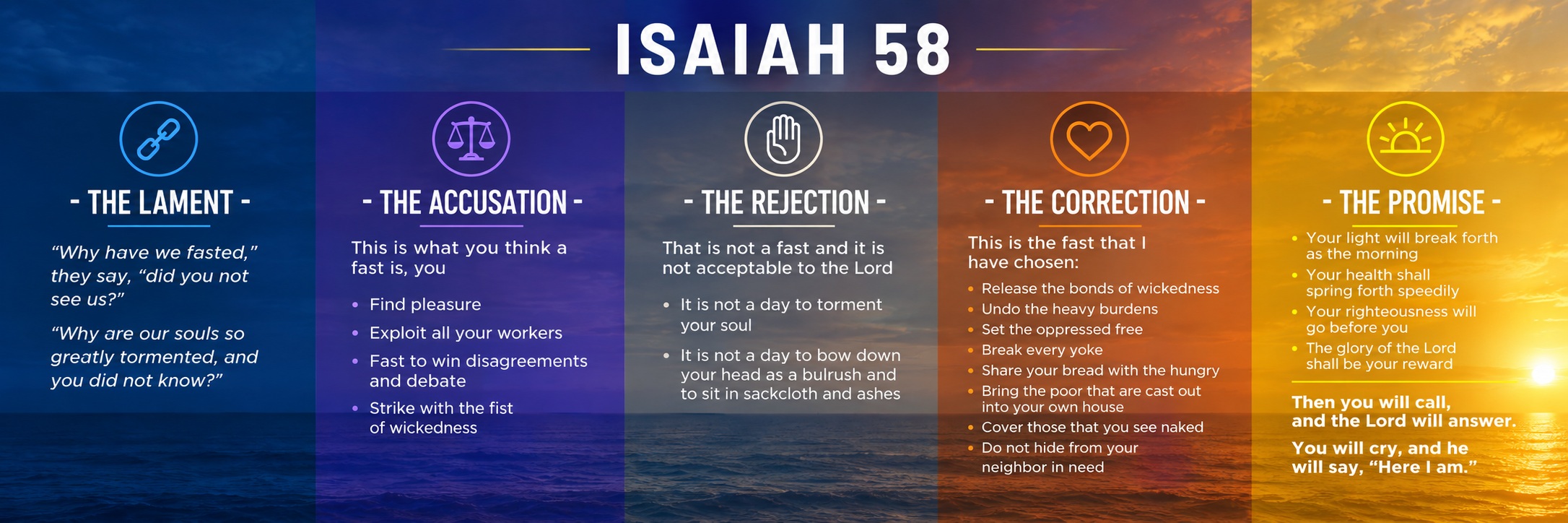
There is a way to practice religion that slowly bends the entire moral universe toward the self.
It does not look selfish.
It looks reverent.
It looks solemn.
It looks pious.
But its center of gravity shifts.
Verse 1
Verse 1
Little Tommy Two Fingers worked his nubs to the bone,
Clocked in at six, coughed blood by noon, but never made a groan.
The whistle blew like judgment day, the gears began to scream,
“Efficiency!” the foreman cried, “We’re beating last year’s scheme!”
The river ran in colors no nature ever chose,
The air hung thick like velvet drapes inside our factory rows.
Tommy smiled through missing teeth, beneath fluorescent glow—
“Productivity is up!” they said. “That’s all you need to know!”
There’s a particular kind of political theater that feels familiar.
It doesn’t feel like oversight.
It doesn’t feel like governance.
It feels like a middle school bus ride.
“Do you know what a rubber is?”
When Kaitlan Collins asked about the Epstein files and justice for survivors, she didn’t get an answer.
She got told to smile.
That moment, more than the policy details, is what has people unsettled.
Let’s try something radical.
I’m not going to argue about women in ministry.
I’m not going to argue about complementarianism.
I’m not going to argue about MAGA.
I’m not going to argue about canon, tithing percentages, or which party cares more about children.
Let’s assume, for a moment, that you are sincere.
There is a difference between conviction and contempt.
There is a difference between loving your country and despising your neighbor.
And there is a profound difference between Christianity and the outrage industry.
One of the biggest obstacles to meaningful reform isn’t ideology, partisanship, or even corruption.
It’s confusion.
Specifically, the confusion between public policy and rent extraction dressed up as governance.
When Donald Trump campaigned on transparency, he promised to release long-sealed government files — including those connected to Jeffrey Epstein.
When Donald Trump campaigned on transparency, he promised to release long-sealed government files — including those connected to Jeffrey Epstein. To many supporters, that promise became proof that he had nothing to hide.
But the actual record tells a more complicated — and more revealing — story.
Trump did not lead the charge to release the Epstein files.
He signed the law only after Congress passed it by a margin so overwhelming that resistance was politically futile, and his administration then missed the statute’s deadline, releasing the material in staggered waves that maximized chaos while minimizing accountability.
Every few months, the phrase “stolen land” resurfaces in American discourse, usually after a celebrity makes a public statement.
Every few months, the phrase “stolen land” resurfaces in American discourse, usually after a celebrity makes a public statement. And almost immediately, the response machine kicks in:
“If you really believe that, give up your house.”
“Donate your mansion.”
“Leave the country.”
This framing is emotionally satisfying for critics — and almost completely useless if the goal is justice.
Let's start with this article as the foundation "What is Authority For?" And then the question is: "If AI was to rule the world, would this be a plausible framework for how it would approach authority?"
Alright, this is a serious foundation. You’re not asking a sci-fi question so much as a moral architecture question. I’ll stay with the grain of the text you gave.
Short answer:
Yes—this would be a plausible and even compelling framework for how an AI could approach authority.
But only if the AI were explicitly designed to treat authority as burdened, provisional, and answerable to the vulnerable rather than as optimization, control, or correctness.
Now let’s unpack that carefully, because the fit is striking—and also where the danger lies.
This started with the article “What is Authority?”
It is a fascinating thought experiment. If an AI were programmed with this specific framework as its “Constitution,” the resulting world would look very different from the cold, logic-driven dystopias we see in sci-fi.
In many ways, this article provides a computational logic for morality that an AI could actually follow—one based on “Impact” rather than “Intent.”
For the sake of her privacy, I have not seen the Melania documentary.
“For the sake of her privacy, I have not seen the Melania documentary.”
That sentence sounds paradoxical only because our culture has confused privacy with selective visibility.
This essay is not about whether a public figure is entitled to private feelings. Everyone is. It is not about voyeurism, gossip, or inner lives. It is about authority — the kind that comes quietly, without election, and accumulates simply by proximity to power.
There’s a quiet rule governing modern work that almost no one says out loud:
You are paid enough to survive — but not enough to repair the system you live inside.
That’s not an accident. It’s a design outcome.
Maybe We've Been Choking on It this Whole Time
The hardest part of redemption is not forgiveness.
It’s identity.
We tend to imagine sin as something we do. A list of actions. A record of mistakes. A moral ledger waiting to be cleared. But the deeper problem is not behavior. It’s attachment.
Every human being eventually finds themselves holding power over someone.
A parent over a child.
A manager over an employee.
A husband or wife inside a marriage.
A pastor over a congregation.
A government over its citizens.
An adult over someone more vulnerable.
Power is not rare. It is ordinary. It accumulates quietly in everyday relationships. And scripture does not pretend otherwise.
There is a simple test for any religious interpretation that is older than most arguments about religion:
If your reading of scripture harms your neighbor, you are reading it wrong.
That statement will sound radical to some people and obvious to others. But it isn’t modern. It isn’t liberal. It isn’t a loophole. It’s embedded in the architecture of the New Testament itself.
There is a quiet skill modern life demands that almost nobody teaches:
knowing when to stop listening.
Not because you’re fragile.
Not because disagreement is scary.
Not because you want an echo chamber.
There is a moment that comes after victory that reveals who we really are.
Not the moment of applause.
Not the trending clip.
Not the ratio.
The moment after—when the consequences arrive.
In politics today, many people never reach that moment. Or rather, they refuse it. They stay suspended in the theater of debate, endlessly performing, endlessly reacting, endlessly “winning,” while reality piles up offstage.